
Engagement ring trends for 2026–2027 are about more freedom in the choice of stone and more intention in the design. Yellow gold, elongated shapes, two-stone rings and sculptural settings are prominent directions. Yet round diamonds and straightforward solitaires still matter. The useful question is not which ring will photograph best this season; it is which design you will enjoy wearing after the proposal, the wedding and the next wave of trends.
This guide separates measured market changes from designers’ observations and our own outlook for 2027. It also shows how to translate a trend into an actual purchase: stone dimensions, setting height, metal composition, wedding-band fit, care and the questions to ask before ordering.
Published October 8, 2026 · By One2Three Jewelry · Focus: US engagement-ring buyers, with practical design comparisons. Our 2027 outlook is a forecast, not a report of future sales. Product examples are from our own collection, so this is a commercial guide with independently linked research.
The answer in 60 seconds
- Most firmly supported shifts: the established role of lab-grown diamonds, the rise of yellow gold, and strong interest in elongated shapes.
- Design directions to explore: bezels, horizontal east-west orientations, Toi et Moi, more substantial bands and vintage-inspired details. Their visibility does not establish a national sales ranking.
- The strongest personal choice: the right footprint, a comfortable setting, clearly described materials and a design that works with your future wedding band.
- For 2027: we expect more variation in proportion, stone combinations and personalization. Do not buy a ring only because someone predicts it will be fashionable.
Prefer to start with the rings? Look at the examples below, then use each section’s buying questions to compare them. Prices are the lowest listed USD variant prices checked on October 8, 2026; options, shipping, taxes and future price changes can affect the final total.

Lab-Grown Diamond Engagement Ring
A round 0.61 ct HPHT lab-grown diamond in solid 14K white gold. An example of choosing a documented material and a restrained size rather than chasing the biggest center stone.
What to check: Ask for the individual stone’s report details, its millimeter measurements and a side-view photograph. The listing describes a 2.55 mm band thickness; clarify width and thickness separately.
From $1,999 USD · Explore this ring →
What the 2026 evidence actually says
A trend report needs a date and a denominator. The Knot’s 2026 Real Weddings Study describes couples who married in 2025, not a complete year of 2026 purchases. Its published findings say 61% chose a lab-grown center stone; the study surveyed 10,474 US couples recruited through The Knot and WeddingWire. It is an important survey, rather than a census of every jewelry buyer. [1]
BriteCo offers a different view: anonymized appraisal records, with its 2026 figures covering January through June. In that dataset, lab-grown centers account for 51% of new engagement-ring appraisals. Different methods and populations explain why the two percentages should not be treated as interchangeable. [2]
| Measure | Reported result | What it helps you understand |
|---|---|---|
| Lab-grown center stones | 51.0% | A mainstream material choice in this sample |
| Round / oval shapes | 32.4% / 22.3% | Round remains ahead; oval is a major alternative |
| Emerald / radiant shapes | 9.1% / 7.4% | Rectangular outlines have meaningful representation |
| Yellow / white gold | 38.2% / 32.4% | Yellow gold leads the individual metal categories |
Source: BriteCo. These are sample-specific shares, not universal US market shares. [2]
Alongside the measured changes, this guide explores design choices such as bezels, horizontal orientations, substantial bands and two-stone compositions. These sections offer practical ways to evaluate a design; they do not establish national sales rankings.
Our interpretation: buyers have more routes to a distinctive ring. That does not mean every couple wants an unconventional design, or that a familiar round solitaire is suddenly outdated. A ring can be current because its proportions suit the wearer, without containing every trend on this page.
1. Yellow gold and a deliberate metal choice
The metal is visible every day, long after you stop looking at an inspiration board. Yellow gold creates a warm frame; white gold emphasizes a cooler palette; rose gold adds a softer contrast. Choose against the jewelry you already wear, rather than a rule about which skin tone is “allowed” to wear which metal.
There are three separate decisions: color, alloy and construction. A gold-colored finish over silver is not the same material as solid gold. The FTC distinguishes gold alloys, plated products and sterling silver; the description should tell you what sits beneath the surface. [3]
Try photographing a sample next to your everyday watch, earrings or wedding band in ordinary daylight. If you like mixed metals, you do not need every piece to match. Decide whether the engagement ring should blend in or become the warm or cool accent in your jewelry collection.

Gold Solitaire Ring with Moissanite
A petite 3 mm round moissanite in solid 14K gold, with yellow, white or rose gold choices. This is a small-scale example of the warm-metal direction, not a large center-stone ring.
What to check: The listing describes a 1.2 mm band thickness. Request the finished width too, and discuss how the slim construction fits your daily activities.
From $299 USD · Explore this ring →
Buying question: “Is this solid gold throughout, what is the karat fineness, and does the selected finish require periodic maintenance?” With white gold, also ask whether it is rhodium plated and what refinishing the maker recommends. With plated silver, ask about the coating and future replating before treating it as equivalent to solid gold.
2. Elongated shapes: oval, radiant and emerald cut
“Elongated” describes an outline, not one particular cutting style. An oval has curved ends, a radiant combines a rectangular or square outline with a brilliant-style facet arrangement, and an emerald cut uses stepped facets. An elongated cushion is another separate shape. The same approximate carat weight can look different across them.
Our most useful comparison is three-dimensional: face-up length and width, depth, and the height of the finished setting. For example, 12 × 8 mm gives a length-to-width ratio of 1.50. That arithmetic describes the outline; it does not establish a cut grade or prove that the stone is more beautiful.
GIA’s research on oval, pear and marquise diamonds shows that shape preferences and visual patterns vary. Compare the actual stone while it moves, including areas of contrast and the bow-tie appearance, rather than accepting a single ratio as a universal ideal. [4]

Oval Moissanite Engagement Ring
A 12 × 8 mm oval moissanite in solid 14K gold, accented with 20 small diamonds. Its long outline makes a substantial visual statement.
What to check: Use the 12 × 8 mm measurements to judge size. Ask whether any quoted moissanite carat figure is actual weight or diamond-equivalent weight, and request a moving video.
From $1,213 USD · Explore this ring →
An oval might suit someone who likes a continuous curved outline. A radiant may appeal to someone who wants an angular frame with a busy sparkle pattern. An emerald cut gives a different rhythm of broad, stepped reflections; GIA notes that inclusions can be more visible in this cutting style. [5]

Radiant Cut Engagement Ring
A 3 ct radiant-cut lab-grown diamond on a 2 mm band of solid 14K gold. This is a larger-scale rectangular option, with yellow, white or rose gold available.
What to check: The listing gives an approximate single dimension, not a complete length × width × depth. Request all three, the individual report and a video of the actual diamond before judging its proportions.
From $4,100 USD · Explore this ring →
On-hand test: take a close photo and another from normal conversation distance. Then bend the finger, close the hand and put on a sleeve. A shape you love in a macro image may feel too wide or too tall in everyday use. There is no obligation to maximize finger coverage.
3. Bezel and east-west settings: two independent choices
A bezel describes a metal rim that secures the stone. East-west describes a horizontal orientation across the finger. A ring can combine both, or use either alone. A north-south bezel and an east-west prong setting are perfectly coherent designs.
GIA’s setting guide explains how a bezel protects the stone’s perimeter, while prongs leave more of the stone exposed. Neither label removes the need to inspect workmanship, and no setting makes a gemstone immune to damage. [6] Explore these options against your own comfort and style priorities.
For an east-west design, compare the total width of the head with the width of the finger. Ask whether adjacent fingers touch the mounting when the hand closes. With a bezel, look at the evenness of the rim, the outline it creates and access for cleaning. A heavy frame can intentionally become part of the design; a lighter frame creates a different look.
A useful custom brief: “I like the horizontal shape, want a comfortable side profile, and need to see how a straight wedding band fits beside it.” Send a photograph of your hand and the wedding band, not only a close-up reference of the center stone.
For a bezel or east-west design, ask us about a custom ring and confirm feasibility, drawings, materials and a complete quote before ordering.
4. Toi et Moi: two stones, one considered composition
Toi et Moi means “you and me” in French. The design places two gemstones alongside one another, often using different shapes or materials. Its symbolism and configuration are described in GIA’s setting guide. [6]
The interesting choice is not simply “two stones instead of one.” It is the relationship between them: equal visual weight or a deliberate contrast, similar color or a colored accent, symmetrical placement or an offset composition. A pair of differently shaped stones can occupy much more width than either alone.

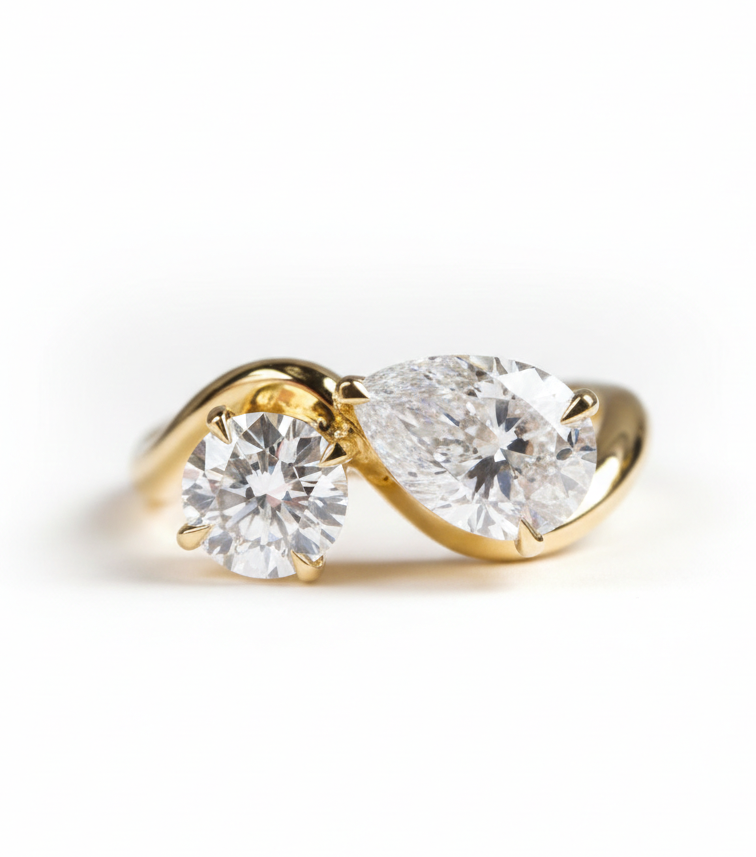
Silver Pear & Round Toi et Moi Moissanite Engagement Ring – 2.20CT
Pear and round moissanites in sterling silver create a contrast between a pointed outline and a circular one. A two-stone example with a different presence from a solitaire.
What to check: Ask for the individual stone dimensions and the overall width and height of the two-stone head. Confirm whether your chosen version is bare silver, rhodium plated or gold plated.
From $499 USD · Explore this ring →
A pear and an emerald cut create a different relationship: soft curvature beside a geometric outline. Remember that emerald cut is a shape; it does not necessarily mean the ring contains a green emerald gemstone.

Silver Pear & Emerald Cut Toi et Moi Engagement Ring – Two Stone Statement Ring
An emerald-cut moissanite paired with a pear-shaped moissanite, in sterling silver with finish options. Both are moissanite; the word “emerald” describes one stone’s cut.
What to check: Request a top view and both side views. Check the spacing of the stones, protection of the pear point and how a wedding band would sit beside the asymmetric head.
From $499 USD · Explore this ring →
Before choosing a mixed-stone pair, put the complete composition beside the clothing and jewelry you wear most often. If you prefer quiet jewelry, a small two-stone ring can be more satisfying than a dramatic version chosen only for its symbolism. If you want a statement, check that its footprint is comfortable when you work or drive.
Ask for each stone separately: material, origin if relevant, measurements, any treatment information, and any applicable report. One total weight is not a complete description of a two-stone ring.
5. Three-stone rings with balanced proportions
Three-stone rings offer a different kind of presence: a central focus supported by two neighboring stones. The familiar past, present and future interpretation is a romantic convention, rather than a rule about who can wear the design. You can choose it simply because you like its proportions.
Build the design from the whole top view. A large difference between the center and sides makes the central stone dominant. Closer sizes create a continuous line of sparkle. Matching outlines and mixed outlines are separate aesthetic choices; neither is automatically more modern.

3 Stone Lab Diamond Engagement Ring
Three round HPHT lab-grown diamonds in solid 14K gold: a 4.45 mm center and two 3.5 mm side stones, with approximately 0.66 ct total weight.
What to check: Compare the complete spread across the finger. Total carat weight includes all three stones and should not be mistaken for the center stone’s weight.
From $1,980 USD · Explore this ring →
For a rectangular center, side stones can continue the geometric language. Ask for a photograph that shows the ring straight on, because perspective can make neighboring stones look larger or smaller than they really are.

2 Carat Emerald Cut Diamond Gold Engagement Ring - Three Stone Ring
A 2 ct emerald-cut CVD lab-grown center diamond with two lab-grown side diamonds totaling 0.5 ct, set in solid 14K gold. The center weight and side-stone total are listed separately.
What to check: The listing mentions a certificate without naming the laboratory. Confirm the issuer, report numbers and the actual center stone’s dimensions; ask which gold colors are currently available.
From $2,800 USD · Explore this ring →
Proportion exercise: compare the same center size with two different side-stone sizes before deciding. The option with less total weight may produce the outline you prefer. The goal is a composition that reads clearly on your hand, not the highest combined carat number.
6. Vintage influence without invented antique claims
Vintage-inspired design can draw on fine beaded edges, engraved surfaces, floral structures or geometric compositions. A newly made ring with historical styling is not an antique, and a cushion outline does not by itself establish an old mine cut.
Decide what you actually enjoy: the stone’s facet pattern, the surface decoration, the metal outline or a sense of personal history. Those are different reasons to choose a ring.

Vintage-Inspired Emerald Ring
A natural 5 mm emerald in solid 14K gold, with milgrain details and two 1.25 mm lab-grown diamond accents. This is a newly made vintage-inspired design.
What to check: Ask about the emerald’s treatments and care, and look at a close image of the actual stone. The historical styling does not change the gemstone’s care requirements.
From $2,132 USD · Explore this ring →
A cushion can express a softer silhouette without being sold as an antique cutting style. Evaluate it on its own terms: the rounded corners, proportions, facet pattern and the way any accent stones frame it.

Cushion Cut Moissanite Ring
A 5 mm cushion-cut moissanite with 36 small moissanite accents on a 2 mm sterling silver band, with finish options. A small-scale cushion example, not a claim of antique-cut provenance.
What to check: Ask which finish your selected option includes and how the accent stones are maintained. If you want an old mine or old European cutting pattern, request that specifically rather than assuming it from the shape.
From $399 USD · Explore this ring →
Personalization idea: start with a simple outline and add one meaningful detail. You might choose an engraving, a particular stone color or a small decorative edge. A design does not need every vintage motif to feel individual.
7. Colored gemstones: personality with realistic care
Color can be the central statement or a smaller accent. Mixed-stone pairings offer another route to a personal design. Explore them because you like their appearance and accept their care needs, rather than assuming colored centers are outselling diamonds.
Separate the color you want from the material that provides it. A blue sapphire and blue topaz are not interchangeable just because they can appear blue. Ask whether the gemstone is natural or laboratory-grown, and what treatments and care instructions apply.
GIA describes sapphire and ruby as corundum, with Mohs hardness 9 and excellent toughness. Treatment can still affect care; heavily filled material should not be treated like untreated or simply heat-treated corundum. [7]

Toi et Moi Blue Sapphire & Moissanite Ring
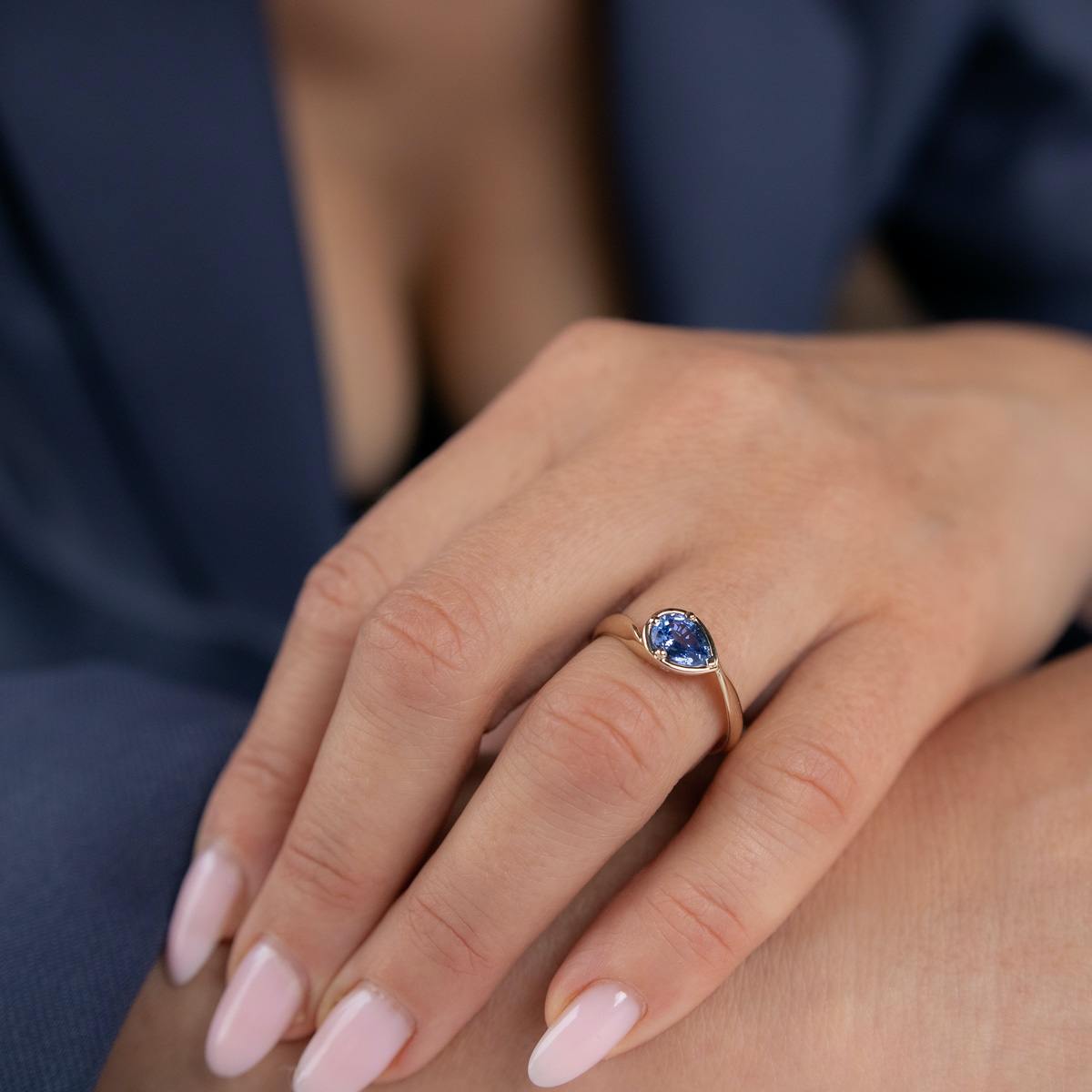
A laboratory-grown blue sapphire paired with a pear-shaped moissanite, in 925 sterling silver with 14K yellow gold plating. A mixed-color example with an explicitly described silver base.
What to check: Confirm the two stone dimensions, coating details and care instructions. This is gold-plated silver, not solid 14K gold; the sapphire is laboratory-grown, not described as natural.
From $599 USD · Explore this ring →
Emerald creates a different mood, but its care deserves particular attention. GIA explains that many emeralds have filled surface-reaching fractures and recommends gentle cleaning; ultrasonic and steam methods can be problematic. [8]

Vintage-Inspired Solo Emerald Ring
A natural 5 mm emerald in a four-prong setting of solid 14K white gold, with other gold colors offered. A restrained way to make green the focal point.
What to check: Ask about filling or other treatment and the recommended care routine. This is a prong-set ring; do not assume the gemstone receives the perimeter protection of a bezel.
From $1,730 USD · Explore this ring →
Our practical advice: choose color because you want to live with it. If the wearer rarely removes jewelry, discuss that habit before choosing a gemstone. If they enjoy careful wear and periodic inspections, the range of viable designs may be broader. A photograph cannot make that decision for you.
8. Band structure, side profiles and thoughtful detail
Consider the metal as part of the design: a substantial, sculptural band creates a different impression from a fine shank. Compare both on your hand and judge their construction, rather than treating either as compulsory.
Ask for width, thickness and setting height separately. A product description may use “band thickness” loosely, so clarify what was measured and where. A wide top that narrows underneath is different from a band with the same dimensions all the way around.
For a larger center, compare side views before increasing the carat weight. For a double-band design, understand the structure between the two rails. For tiny accent stones, ask how inspections, cleaning and possible replacement are handled. A dramatic outline and easy maintenance are not necessarily the same priority.

Double Band Engagement Ring with Moissanite
A 6.5 mm round moissanite with 72 small diamond accents in a double-band design of solid 14K gold. This illustrates a more architectural arrangement of metal and sparkle.
What to check: Request overall width, the spacing between the bands, a side view and the maintenance process for the pavé. Do not assume a double band automatically means a low-profile or heavier-built ring.
From $899 USD · Explore this ring →
Hidden halos and subtle profile details can be meaningful when they are chosen consciously. Ask whether a detail will actually be visible while wearing the ring, and whether the extra stones change service needs or wedding-band clearance. If the top view matters most to you, spend your design attention there.
There is no universal safe minimum band dimension. Material, shape, construction, stone size and daily wear all matter. A short numeric rule from a social post cannot replace a discussion of the finished ring.
9. Minimalism beyond oversized solitaires
A minimalist ring is a design choice, not a mandatory small stone or a particular budget. You may prefer a generous center with a quiet setting, or a petite center whose scale feels natural with your everyday jewelry.
One useful test is to remove the language around the ring. Would you still like it if it were not described as “quiet luxury,” “old money” or a celebrity favorite? The answer tells you more about longevity than the trend label.

Simple Diamond Ring
A 2.5 mm center diamond and six 1 mm diamond accents in solid 14K gold. A deliberately dainty alternative to a large solitaire.
What to check: The listing does not explicitly state natural or laboratory-grown origin for these diamonds. Confirm that before ordering, and discuss the 1 mm band width in relation to how you will wear it.
From $299 USD · Explore this ring →
A small ring may make sense for someone who likes discreet jewelry, has a practical budget, or plans to pair it with a stronger wedding band. A larger stone may make sense for someone who enjoys a focal piece. Neither says how serious the relationship is.
Personal style test: choose three photographs of your own outfits, not three photographs of rings. Use them to decide whether the ring should be delicate, geometric, colorful, traditional or conspicuous. Then choose the material and construction that can deliver that look.
10. Lab-grown diamond, natural diamond or moissanite
Natural and laboratory-grown diamonds are diamond; their growth origins differ. Moissanite is a different gemstone, not another name for a lab-grown diamond. GIA explains the distinction between natural and laboratory-grown diamonds, and its gemstone-imitation guide identifies moissanite as a diamond alternative with different properties. [9] [10]
For a fair shopping comparison, hold the design roughly constant: similar visible dimensions, the same metal, comparable construction and a similar service package. Comparing a large plated-silver moissanite ring with a small solid-gold diamond ring answers several questions at once and cannot isolate the price of the gemstone.

Moissanite Ring with Diamonds
A 6.5 mm round moissanite and four 1 mm diamond accents in solid 14K gold. An example of a ring combining different gemstone materials.
What to check: Ask about the origin of the diamond accents and the meaning of any moissanite carat-equivalent number. The center is moissanite; the presence of diamond accents does not make it a diamond-center ring.
From $525 USD · Explore this ring →
A 2026 documentation detail worth knowing: GIA’s current service for eligible colorless-to-near-colorless laboratory-grown diamonds uses an overall Premium or Standard quality assessment. Do not assume every current lab-grown GIA document uses the same format as a natural-diamond report. Check the issuer, issue date and actual document. [11]
A statement such as “certificate included” is not enough to identify the laboratory or the information being certified. Seller quality terms and a laboratory report are different things. If you want a report for a particular stone, make that part of the order discussion rather than an assumption after purchase.
Environmental claims also need specifics. Laboratory-grown origin alone does not prove every part of a ring’s production is sustainable. The FTC has warned jewelry advertisers about unsupported broad environmental claims. [12] Ask what a claim covers and what evidence supports it.
For a deeper comparison of sparkle, care, size and identification, read our Moissanite vs Diamond guide. Choose the material you actually want to own, and budget for the finished jewelry rather than treating the ring as a promised investment.
11. Design the engagement ring and wedding band together
The future wedding band is often missing from engagement-ring inspiration photographs. Decide early whether you want a straight band to sit beside the ring, a contour that follows its head, a visible gap, or two rings worn on separate hands.
Before ordering, ask for a side-view comparison with the proposed band. Check whether the stone basket, decorative elements or points contact the neighboring ring. Ask the maker how the two pieces should be worn and maintained together.

Curved Wedding Band
A curved band of solid 14K gold with 11 small diamonds. It illustrates one route to framing an engagement ring rather than assuming a straight band will fit.
What to check: This is not a guaranteed match for every ring shown here. Request an exact fit comparison, with the engagement ring’s head dimensions and your chosen sizes.
From $249 USD · Explore this ring →
Do not choose a contour only from a top-view image. A curve that looks attractive on its own may leave more space than you expected, or touch the ring in a place you did not intend. If you will buy the band later, keep the original ring measurements and design information.
Stacking exercise: compare one simple band, one contour and no band at all. Think about the combined width and your normal activities. More rings are not automatically a more complete look.
Our 2027 outlook: what may endure, and what remains uncertain
The following is One2Three Jewelry’s editorial forecast as of October 8, 2026. We do not yet have a full-year 2027 sales dataset. These are reasoned directions to watch, not measured future market shares.
| Direction | Our outlook | Reasoning | What could change it |
|---|---|---|---|
| Lab-grown diamond choice | Likely to remain established | Already substantial in two different datasets | Pricing, supplier quality and consumer preferences |
| Yellow gold | Likely to remain prominent | Current data and a long-lived visual language | Metal prices and renewed interest in white metals |
| Elongated outlines | Likely to stay varied | Several shapes deliver the look differently | Round classics and changing proportion preferences |
| Bezel and east-west | Design interest may continue | Distinctive silhouettes with practical questions worth exploring | Comfort, execution and wedding-band fit |
| Personal stone pairings | May become more individual | Two-stone layouts allow meaningful combinations | Care, cost and the wearer’s preference for simplicity |
The most plausible change is more variation within familiar categories: several kinds of oval rings, different weights of gold, restrained and bold Toi et Moi compositions, and more deliberate choices between a statement stone and a modest center.
We would not predict the “death” of round diamonds, white gold, halos or delicate rings. Current data already show the problem with that framing: a visible new direction can coexist with a popular established choice. Fashion coverage tends to emphasize what is novel; a personal purchase needs room for what you already like.
What will matter after 2027: whether the ring fits, whether you understand the materials, whether its maintenance is manageable and whether its outline still feels like you. Those are more useful selection criteria than trying to guess the next social-media favorite.
How to build a useful shortlist and budget
Start with a complete spending limit that leaves room for the wedding band and any near-term service needs. There is no need to make the budget conform to a salary formula. GIA’s buying guidance also recommends choosing a budget and considering the wearer’s preferences. [13]
Then create a shortlist of three rings with different priorities:
- The simplest version: the material and shape you want with limited decoration.
- The expressive version: the detail or composition that makes you excited to wear it.
- The practical alternative: a different size or material that gives you a similar visual idea within a comfortable total.
Make a small comparison sheet. Record center material, individual stone dimensions, metal and finish, band width and thickness, setting height, total head width, documentation, production timing, delivery estimate, resizing terms and final price. A blank field is a question to ask, not a reason to guess.
Our examples span petite solid-gold rings, plated-silver two-stone designs and larger lab-grown diamond rings. That range shows different routes through the design decisions; it is not a like-for-like price ranking or a statement that every ring has the same wear characteristics.
Choose a finalist in ordinary conditions: look at a moving video, compare scale on a hand, and imagine the ring with your normal clothing. If you are buying a surprise, use jewelry the recipient already wears as evidence, and discuss the exchange or sizing route before the proposal.
Your pre-order checklist
- Stone: natural diamond, laboratory-grown diamond, moissanite or another gemstone? Identify every material in a mixed-stone design.
- Measurements: length × width × depth, center weight and total weight; clarify diamond-equivalent wording for moissanite.
- Appearance: video of the actual stone or the exact made-to-order specification; distinguish sample photos from the finished item.
- Metal: solid gold, silver or plated silver; alloy fineness, coating and chosen color.
- Construction: width, thickness, head height, total spread and side views.
- Fit: ring size and how the future wedding band sits beside it.
- Documentation: report issuer and number where applicable, treatments and written material descriptions.
- Timing: production time, engraving time and shipping time separately; leave room before a proposal date.
- Service: resizing, inspection, repair and return terms for the exact order and any discount.
- Price: the selected variant, custom changes, tax, delivery and anything excluded from the quote.
For a personalized design, use our Custom Rings page. Before ordering, read Returns & Resizes, including applicable exclusions for discounted or coupon purchases. If the written product description leaves a material or dimension unclear, ask us to confirm it.
Frequently asked questions
What are the biggest engagement ring trends for 2026?
Lab-grown diamond choice, yellow gold and elongated shapes are supported by recent data. This guide also explores bezels, east-west orientations, Toi et Moi and substantial bands as design options. These suggestions are not national sales rankings.
What engagement rings will be popular in 2027?
We expect continued interest in warm metals, elongated shapes, personal stone pairings and considered setting proportions. This is our forecast as of October 2026, not measured 2027 sales. Choose a ring you like wearing rather than buying solely around a prediction.
Are oval engagement rings more popular than round rings?
Not in BriteCo’s January–June 2026 engagement-ring data: round remains ahead of oval. Oval is a significant alternative. Social-media visibility alone cannot establish that one shape has overtaken another in sales.
Are white gold and round solitaires outdated?
No. A newer direction does not make an established design unsuitable. Decide from your existing jewelry, preferred outline and daily wear. Current market data still give round shapes and white gold substantial representation.
Is an east-west ring always bezel set?
No. East-west describes horizontal orientation; bezel describes how a metal rim secures the stone. An east-west ring can be prong set, and a bezel ring can have a vertical orientation.
Is a bezel engagement ring damage-proof?
No. A bezel can protect the stone’s perimeter, but material, workmanship and wear still matter. Inspect the rim, setting height and access for cleaning; ask how the finished design should be maintained.
What is a Toi et Moi ring?
A two-stone ring, commonly associated with the French phrase “you and me.” The stones may have matching or different shapes and materials. Ask for both stone descriptions and the total head dimensions.
Does emerald cut mean an emerald gemstone?
No. Emerald cut describes a cutting style. A ring can contain an emerald-cut diamond or moissanite. A green emerald is a separate gemstone material; read the description rather than inferring material from the shape name.
Is moissanite the same as a laboratory-grown diamond?
No. A laboratory-grown diamond is diamond with a laboratory growth origin. Moissanite is a different gemstone. A ring may combine a moissanite center with diamond accents, so identify each material separately.
How do I compare a large moissanite ring with a diamond ring?
Start with visible dimensions, setting and metal, not only a carat figure. Clarify actual weight versus diamond-equivalent wording for moissanite, and keep the design and service package reasonably similar when comparing prices.
Can I choose a colored gemstone engagement ring?
Yes, if you like the color and accept the gemstone’s care needs. Ask about natural or laboratory-grown origin and treatments. Sapphire and ruby have different care considerations from emerald; no broad gemstone label replaces instructions for your specific stone.
Is gold-plated silver the same as solid gold?
No. The base material is silver and the gold is a surface layer. Ask about coating and maintenance. A plated ring may give you a color you enjoy, but it should not be described or priced on the assumption that it is solid gold.
Will any curved wedding band fit my engagement ring?
No. Compare the exact contour, head height, basket and dimensions. Ask for a side-view fit check with the intended ring and size. A curved band shown as an example is not a guaranteed match.
What should I ask about a diamond certificate in 2026?
Ask for the issuer, report number, date and the individual stone it describes. GIA’s current eligible colorless-to-near-colorless laboratory-grown service uses Premium or Standard quality assessments. A seller’s certificate and an independent laboratory document may provide different information.
How should I care for an engagement ring?
Follow instructions for the complete ring and its most care-sensitive component. Remove it for activities likely to bend the metal or strike the stone, and arrange inspections appropriate to the design. Diamond resists scratching but can chip; treated emeralds and some treated colored stones need particular care.
How much should I spend on an engagement ring?
Choose a total you can comfortably afford, including the band, chosen options and any relevant service or delivery costs. There is no useful reason to force your purchase into a salary rule. Compare complete specifications and ask about return and resizing terms before paying.
Gemstone care references: GIA’s diamond, sapphire and emerald care guides. [14] [7] [8]
Sources and editorial approach
We reviewed these sources on October 8, 2026. Survey findings and appraisal data answer different questions and are identified accordingly. Practical shopping exercises and the 2027 outlook are our editorial advice. We have not conducted a controlled wear or optical test of every product shown.
- The Knot — Welcome to the Era of Lab-Grown Diamonds. 2026 study findings and methodology; survey of US couples married in 2025.
- BriteCo — Jewelry, Diamond & Watch Price Index 2026. Appraisal-based measures; 2026 figures cover January–June.
- FTC — Buying Platinum, Gold and Silver Jewelry. Metal composition, alloys and plated-jewelry terminology.
- GIA — Observations of Oval-, Pear- and Marquise-Shaped Diamonds. Research on fancy-shaped diamond appearance; not a moissanite grading study.
- GIA — Emerald Cut Diamond Buying Guide. Step-cut diamond appearance and buying considerations.
- GIA — Guide to Engagement Ring Settings. Settings and styles, including bezel and Toi et Moi; published August 2026.
- GIA — Sapphire Care and Cleaning. Corundum durability and treatment-dependent care.
- GIA — Emerald Care and Cleaning. Fracture filling, stability and appropriate cleaning.
- GIA — Natural and Laboratory-Grown Diamonds. Material identity and growth-origin distinctions.
- GIA — Gemstone Imitations. Distinguishes diamond alternatives, including moissanite.
- GIA — Laboratory-Grown Diamond Services. Current quality-assessment services and document descriptions.
- FTC — Diamond Ad Disclosure Warning Letters. Clear origin descriptions and evidence for environmental advertising claims.
- GIA — 10 Tips for Buying an Engagement Ring. General buying priorities and budget considerations.
- GIA — Diamond Care and Cleaning. Hardness, toughness, impact and cleaning considerations.
Product specifications and starting prices were checked against the live One2Three catalog on the publication date. Some listings do not give every measurement, origin detail or report issuer; the guide flags these as questions to confirm rather than filling the gaps with assumptions. Product availability, variants and prices can change.
Explore further: Moissanite vs Diamond · Create a custom ring · Returns & Resizes
