
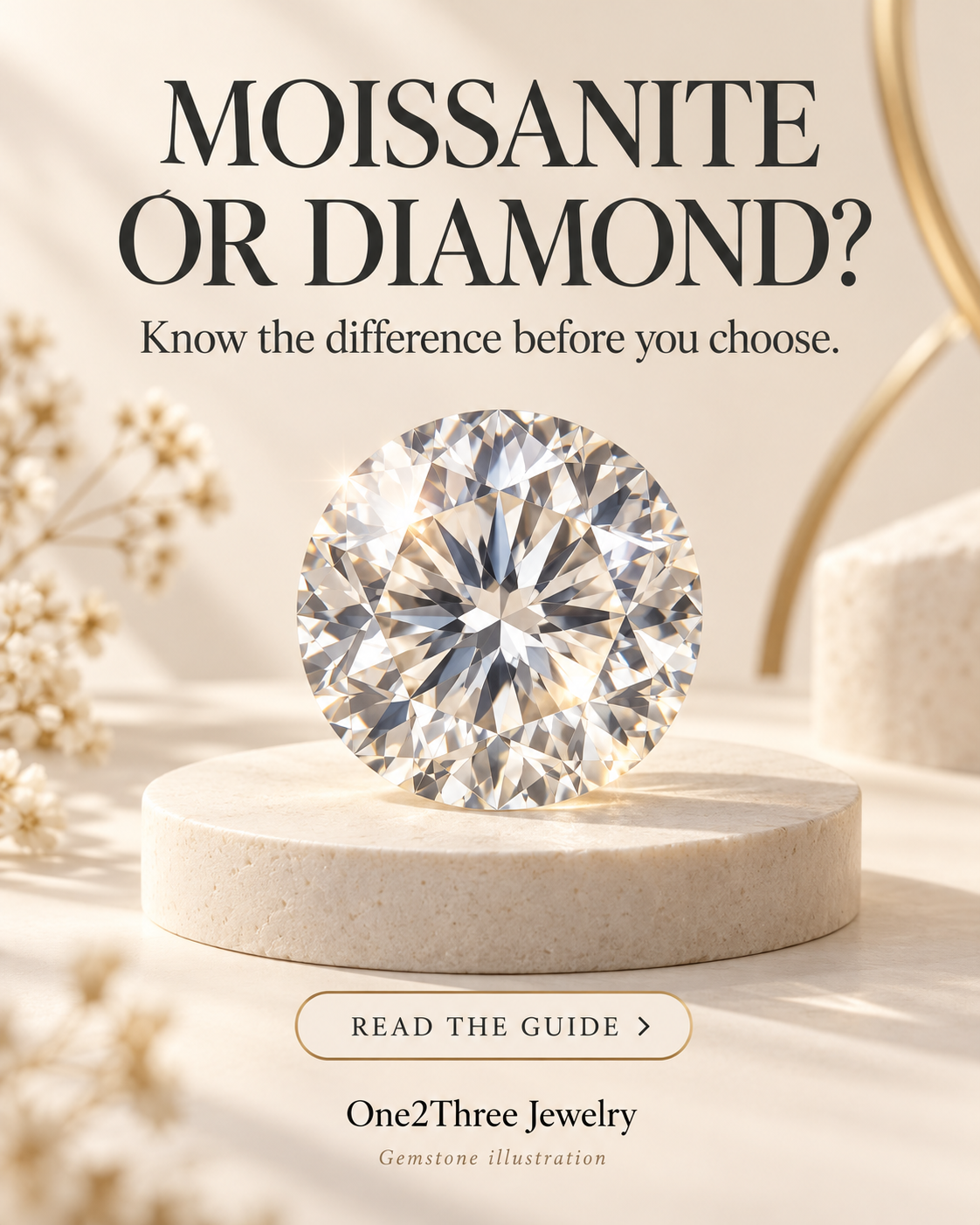
Moissanite and diamond can both be beautiful choices for a ring, but they are different gemstones. This guide explains the differences that affect what you see, what you pay for and how your jewelry fits your life. It also separates natural diamond, laboratory-grown diamond and laboratory-created moissanite—three names that should never be treated as interchangeable.
Updated October 8, 2026 · Published by One2Three Jewelry. Gemstone facts are linked to GIA and FTC sources; buying suggestions are our editorial guidance. Product examples come from our own store. We have not conducted a controlled optical or wear test of the products below.
Moissanite vs natural diamond vs laboratory-grown diamond
The most important distinction is material, not where the stone was made. Laboratory-grown diamond belongs in the diamond column; laboratory-created moissanite does not. [2]
| Feature | Moissanite | Natural diamond | Laboratory-grown diamond |
|---|---|---|---|
| Material | Silicon carbide (SiC) | Carbon | Carbon |
| Origin | Jewelry stones are typically laboratory-created | Formed naturally | Grown in a laboratory |
| Mohs hardness | About 9¼ | 10 | 10 |
| Visible fire | More pronounced rainbow flashes | Depends on cut and lighting | Diamond optical behavior; depends on cut and lighting |
| Refraction | Double refraction | Single refraction | Single refraction |
| Everyday selection | Judge the stone and complete setting | Judge the stone and complete setting | Judge the stone and complete setting |
| Identification | Professional testing distinguishes it from diamond | Laboratory examination can establish origin | Laboratory examination can establish origin |
| Price comparison | Match dimensions, metal, setting and stone specifications; a ring price is not a gemstone-only price | ||
Material and optical comparison: sources [1][2][3][4]. The table describes gemstone categories, not a guarantee about a particular listing.
Start with two different finished-ring examples
These dainty rings illustrate why a similar budget can buy different materials and stone sizes. They are not matched specimens for comparing sparkle.

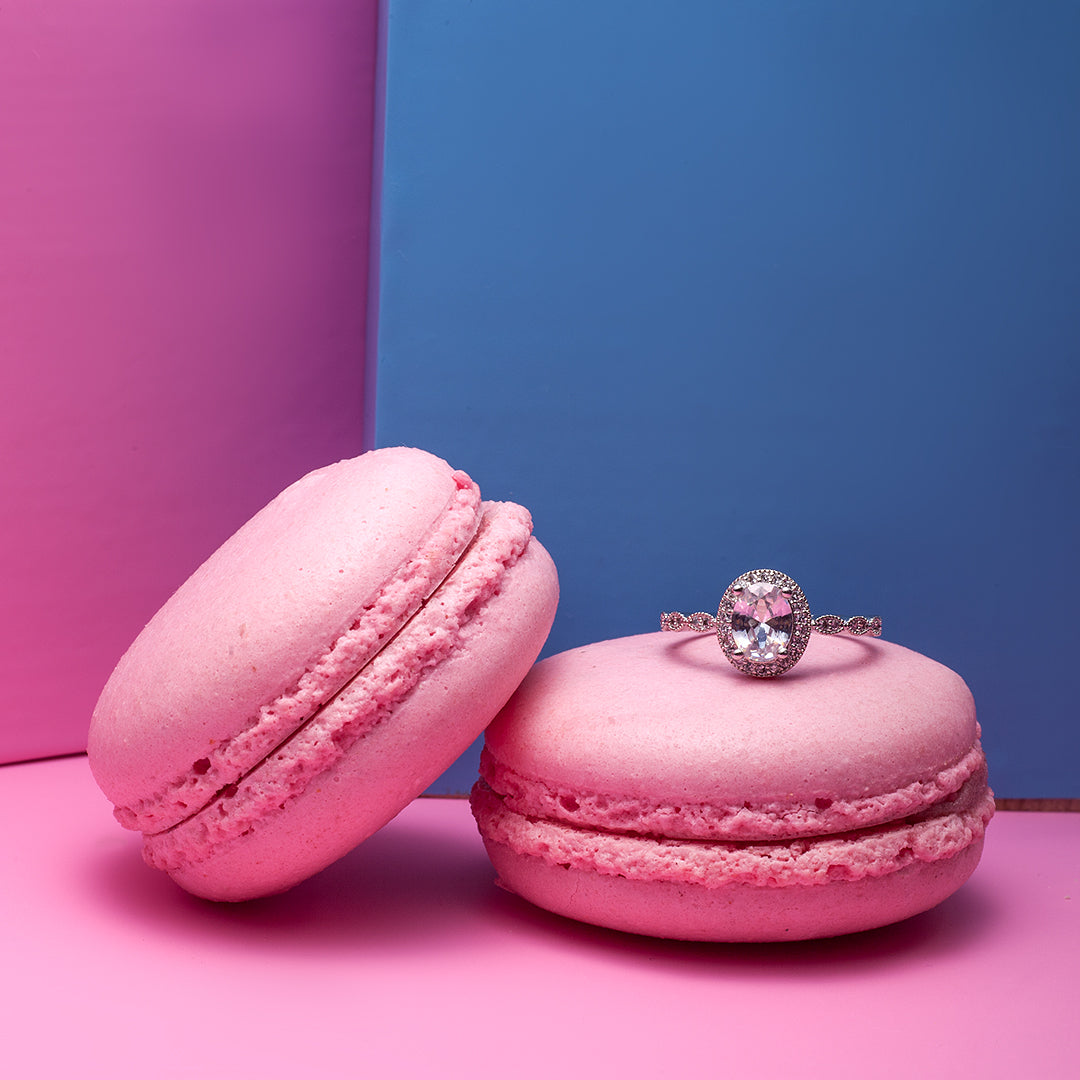
Silver Moissanite Promise Ring
925 sterling silver · 3.5 mm moissanite center with 1.9 mm side stones.
An example for a small center stone and a delicate promise-ring style.
From $269.00 USD

Simple Diamond Ring
Solid 14K gold · 2.5 mm diamond center with six 1 mm diamond accents.
An example for a smaller diamond-centered design. Confirm diamond origin with the seller if natural versus laboratory-grown is important to you.
From $299.00 USD
1. What is moissanite—and is it a “fake diamond”?
Moissanite is a gemstone in its own right, not a variety of diamond. In gemology, a material used to resemble another gemstone is called a simulant. That describes its role as a substitute; it does not make an honestly labeled moissanite fraudulent. Problems arise when a different material is sold as diamond. [1][9]
Natural diamond and laboratory-grown diamond share essentially the same chemical, physical and optical properties. Their origins differ, and trained laboratories can identify the subtle differences. Moissanite has a different composition and optical behavior. [2]
Read the entire description, not just the product name
A listing can describe a moissanite center and diamond side stones in the same ring. Ask which stone the stated color, clarity and carat weight refer to. An attractive title is not a substitute for a clear material breakdown.
Our buying advice: write down the center gemstone, accent gemstones, metal and dimensions before comparing prices. If one is missing, ask before ordering. “Lab-created” without a named material leaves a crucial question unanswered.
2. Sparkle: fire, brilliance and what you see in real life
More rainbow fire is a visual preference, not a universal quality score. Fire is colored light produced by dispersion. Brilliance is the impression of white-light return; the flashes that appear as a stone moves are often discussed as scintillation. Moissanite's higher dispersion can make its rainbow flashes more noticeable than diamond's. [1][4]
GIA's classic moissanite research reports refractive indices of 2.648 and 2.691 and dispersion of 0.104; GIA lists diamond's refractive index as 2.42. These numbers explain differences in optical behavior, but do not rank the beauty of finished rings. [3][4]
A useful three-light comparison
- Indirect daylight: look at the overall face-up appearance and whether you enjoy the color.
- Ordinary indoor light: judge the look you will see at home or work.
- A small bright light: notice the flashes as the hand moves, rather than judging one frozen image.
This is a shopping exercise, not an authentication test. Ask for the same stone moving slowly, with the camera at a normal viewing distance. Strong studio lighting, close-up magnification and editing can make two photographs poor comparison material.
If you prefer a quiet, delicate look, compare a smaller center stone and a simpler layout. If you enjoy broad sparkle across the finger, compare a multi-stone design. Neither preference requires pretending that the gemstones are identical.

Five Moissanite Engagement Ring
Solid 14K gold · 4.5 mm center with four graduated moissanite side stones.
A useful example of sparkle distributed across several stones.
From $483.00 USD

Modern Classic Moissanite Promise Ring
925 sterling silver · 3.5 mm center and 1.9 mm side stones.
Compare the complete silhouette with the other dainty designs, using a hand photo and video.
From $299.00 USD
3. Durability: hardness does not mean indestructible
Diamond is harder than moissanite, but hardness is only one part of durability. GIA distinguishes scratch resistance (hardness), resistance to breaking or chipping (toughness), and resistance to heat or chemicals (stability). The Mohs scale is not linear, so 9¼ versus 10 is not a percentage calculation. Even diamond can chip when struck in an unfavorable direction. [5]
Moissanite's approximately 9¼ hardness makes it a hard gemstone suitable for jewelry, including engagement rings. [1][4] However, a hard stone cannot prevent a thin band from bending or a worn prong from loosening.
Evaluate the ring as a small structure
- Check the stone security and the condition of the prongs.
- Ask for the band's width and thickness separately; those terms are sometimes mixed in listings.
- Consider the side profile if you wear gloves, work with your hands or dislike tall settings.
- Remove rings for activities that expose them to hard impacts or pressure.
Care for the complete piece
Follow the seller's care instructions for the metal, finish and every gemstone in the piece. Use a gentle cleaning method appropriate to all of them; do not assume that a method safe for a loose diamond is safe for a mixed-stone ring. If a stone moves, a prong catches or a band changes shape, stop wearing it and ask a jeweler to inspect it.
Do not scratch, burn or shock a stone to identify it. GIA describes both diamond chipping and damage from extreme heat or temperature changes. [5] Our recommendation is professional, non-destructive examination whenever identity is uncertain.
4. Carats, diamond-equivalent weight and millimeter size
Carat is a unit of weight, not a measure of diameter. One metric carat equals 200 milligrams. Two stones of the same carat weight can have different proportions and visible sizes. [6]
Diamond and moissanite also have different densities: GIA gives diamond a specific gravity of approximately 3.52; the classic moissanite study reports 3.22. [3][4] Equal weight therefore does not establish equal dimensions. Cutting proportions add another difference.
Ask what an advertised moissanite carat number means
A seller may give actual stone weight, a diamond-equivalent size label, or a total for multiple stones. Ask explicitly: “Is this the measured weight of the moissanite, a diamond-equivalent description, or the combined weight of all stones?” Then request length, width and depth in millimeters.
For example, a listing that states “8 × 10 mm” and “diamond equivalent 3 ct” provides two different kinds of information. The equivalent label does not mean you are receiving a three-carat diamond. A length-to-width ratio can help you compare silhouettes: 10 ÷ 8 = 1.25. That simple calculation describes outline, not cut quality.
For a ring, compare the center stone's dimensions with the band width and ask for an image on a hand with a known ring size. For earrings, check whether the quoted weight is for one stone or the pair. For a cluster, distinguish center weight from total weight.
5. Shape versus cut: round, oval and pear
Shape describes the outline; cut describes how the stone's proportions and facets manage light. A shape you love can still have an appearance you do not enjoy. Compare the actual stone, not just the category name.
Round
Start here if you prefer a symmetrical outline. Ask for a straight-on video and a side view, and compare the center diameter with the whole setting. A halo makes the ring outline larger without making the center stone itself larger.
Oval
Compare length-to-width ratio and the moving pattern of bright and dark areas. GIA's research on oval, pear and marquise diamonds shows why face-up contrast matters, including the central dark pattern commonly called a bow tie. [7] That study concerns diamonds; do not use its findings to assign a laboratory cut grade to a moissanite. Use a video to judge the individual moissanite you are buying.
Pear
Decide whether you enjoy the pointed silhouette and ask how the tip is protected by the setting. Check the side view, wedding-band clearance and whether the ring will be comfortable in your usual activities. The best shape is the one you enjoy in the finished piece, at a useful viewing distance.

Oval Moissanite Engagement Ring
Solid 14K gold · 12 × 8 mm oval moissanite center with diamond accents.
A larger oval example: judge the dimensions and setting together rather than relying on the listing's carat label.
From $1213.00 USD

Pear-Shaped Moissanite Engagement Ring
Solid 14K gold · 6 × 8 mm pear moissanite with 12 diamond accents.
Compare the pointed outline, tip protection and side profile before choosing.
From $945.00 USD
6. The metal and setting can change the decision
Choosing the stone is only half the purchase. The same gemstone can be placed in rings with different metals, band dimensions, stone heights and service requirements. Compare those details before attributing a price difference to moissanite versus diamond.
Our practical approach is to request four views: straight-on, side profile, underside and on a hand. Together they help you understand the stone layout, how high the ring sits and how a wedding band might meet it. Photos support a conversation with the jeweler; they cannot certify structural strength.
- Metal: confirm the alloy and whether the color comes from solid metal, plating or another finish.
- Setting: ask how the center and accents are secured and what inspection or maintenance is recommended.
- Band: ask for both width and thickness, plus resizing limitations.
- Wedding-band fit: ask whether the pictured band is included and whether it fits flush.
A stone's hardness number does not answer these questions. If you prefer a very delicate band, discuss how that design suits your lifestyle instead of assuming that any diamond or moissanite ring will behave the same way.

Cathedral Engagement Ring
Solid 14K gold · 7 mm moissanite center with 24 diamond accents.
Use the side-profile images to understand the cathedral design and ask about matching-band fit.
From $735.00 USD

Moissanite Wedding Set
Solid 14K gold · 6.5 mm moissanite center with diamond accents; listing price covers two rings.
A complete-set example: compare what is included as well as the center stone.
From $744.00 USD
7. Price and value: compare a complete specification
A cheaper ring does not prove that its center gemstone is cheaper on an equal basis. A silver ring with a small stone and a gold ring with a larger one are different purchases. Store examples are useful for planning a budget, but they cannot establish a market-wide savings percentage.
Build a comparison with six columns
- Center gemstone and disclosed origin.
- Dimensions, actual weight or clearly labeled equivalent.
- Cut, color and clarity information, with who supplied it.
- Accent stones and the metal specification.
- Setting, band dimensions and included pieces.
- Delivered cost and aftercare terms.
Compare two quotes with the same specification as closely as possible. If you change the center size, metal or stone layout, record that change. This is more useful than a broad “moissanite saves X%” claim with no matched examples.
Two gold-ring options with different stone layouts
Both examples below use solid 14K gold, but their centers and accent materials differ. Ask for matching videos and complete specifications if you want to compare them closely.

Moissanite Ring with Diamonds
Solid 14K gold · 6.5 mm moissanite center and four diamond accents.
An example that combines moissanite and diamonds in one piece.
From $525.00 USD
Five Moissanite Engagement Ring
Solid 14K gold · graduated all-moissanite stone layout.
Compare the smaller center and five-stone spread against a single larger-center design.
From $483.00 USD
Product prices are the current minimum variant prices checked October 8, 2026, not an appraisal or a promise about future value. Check the product page for your selected variant.
Purchase value versus resale expectations
Our recommendation is to set a budget for the jewelry you want to wear, rather than assuming that a retail purchase will earn a return. If resale or an upgrade is important, obtain the seller's written buyback or trade-in terms before buying. An appraisal, asking price and actual resale offer answer different questions; do not treat them as interchangeable.
8. Diamond testers, certificates and misleading labels
A thermal-only tester is not conclusive proof that a stone is diamond. Moissanite and diamond both conduct heat well. GIA documents identification using properties such as double refraction, and even a moissanite carrying a fraudulent GIA inscription. [8] The FTC's guidance also addresses tester limitations and clear disclosure of stone identity. [9]
What to ask about a report
- Who issued it, and what exactly does it identify or grade?
- Does the report describe the center stone or the entire piece?
- Do its dimensions and identifying details match the stone being sold?
- Can the report be verified with its issuing laboratory?
- Is the document an independent laboratory report, a seller certificate or an appraisal?
A seller's “AAA,” “premium” or diamond-style color/clarity description for moissanite should be read with its stated issuer and criteria. Do not assume it is a GIA diamond grading report. If documentation is important to your decision, ask what is actually supplied rather than inferring it from a product name.
To establish natural versus laboratory-grown diamond origin, use a suitable gemological laboratory. Looking at a photo, checking whether the stone feels cool or counting rainbow flashes is not a reliable substitute. [2]
9. Buying a loose moissanite for a custom ring
A loose stone gives you flexibility, but it also creates a separate setting project. Agree on compatibility with your jeweler before buying the stone. Length and width are a starting point; the stone's depth and the setting's geometry also need to be considered.
Ask who is responsible for checking the stone, setting it, insuring it in transit or during work, and resolving a mismatch. Get a quote for the finished ring—not just the loose stone—before making the purchase.

Loose Oval Moissanite — 2.72 ct
8 × 10 mm oval moissanite · listed actual weight 2.72 ct; diamond-equivalent description 3 ct.
Stone only; a ring setting is not included. Confirm depth and suitability with your jeweler.
From $898.00 USD
Explore our loose gemstone collection or discuss a setting through custom rings. Ask which specifications and documentation will accompany the stone and how a custom order's terms differ from a standard purchase.
10. The same decision applies to earrings and necklaces
The gemstone comparison stays the same, but the practical questions change with the piece. For earrings, check dimensions per stone, total pair weight, the fastening and how they sit on the ear. For a necklace, check chain length, metal, pendant proportions and what the quoted price includes.
If you are buying a gift and do not know a ring size, earrings or a necklace can be another route. Ask the recipient's preferences rather than assuming that everyone wants the largest stone or the brightest fire.

Moissanite Studs with Diamond Accents
Solid 14K gold · 5 mm moissanite centers with diamond accents.
Check the pair specifications and fastening, not just the center-stone label.
From $669.00 USD

Moissanite Necklace
Solid 14K gold · 6.5 mm moissanite · 40 cm gold chain included.
Compare the pendant at normal wearing distance and check whether the chain length suits you.
From $610.00 USD
11. Which should you choose?
Choose the material you want, then choose the complete piece you can comfortably afford and maintain. There is no universal winner that removes those decisions.
- Choose moissanite if you enjoy its appearance and want that gemstone, with clear labeling.
- Compare laboratory-grown diamond if you specifically want diamond material and prefer a laboratory origin.
- Compare natural diamond if natural origin is part of what you value, supported by appropriate disclosure and documentation.
- Start with the design if comfort, symbolism or a delicate silhouette matters more than a large center.
As a useful exercise, name your top three priorities: appearance, origin, dimensions, budget, comfort or design. Use them to narrow the options, then request comparable photographs and specifications. This makes the choice personal without relying on a vague ranking of gemstones.
What about environmental and ethical claims?
Laboratory origin alone does not substantiate every “eco-friendly” or “sustainable” claim. The FTC has warned jewelry sellers about broad environmental claims without adequate supporting evidence. [10] Ask for the specific claim, what part of the product it covers and what evidence supports it. Treat sourcing transparency as a question to investigate, not a benefit automatically established by a gemstone name.
12. Save this checklist before ordering
- Material: what are the center and accent stones, and is their origin clearly stated?
- Size: what are the millimeter dimensions and does “carat” mean actual, equivalent or total weight?
- Appearance: can you see the exact stone or a clearly identified representative piece moving in ordinary light?
- Construction: what are the metal, band width, thickness, setting height and finish?
- Fit: is your ring size confirmed, and how will a wedding band meet the setting?
- Documentation: what report or seller information is included?
- Cost: what does the selected variant cost, including shipping and agreed customization?
- Service: what are the current delivery, resizing, repair and return conditions—including any conditions for discounted or custom orders?
Start with our ring size guide, then read the current return and resizing information and production and shipping details.
A useful message to the jeweler: “Please confirm the center and accent gemstones, their origin, millimeter dimensions, metal and band measurements. Can I see a side view and a video in normal light, and get the complete price and service terms?”

Moissanite vs diamond: frequently asked questions
Is moissanite a real diamond?
No. Moissanite is a real gemstone made of silicon carbide, but it is not diamond. Natural and laboratory-grown diamonds are carbon.
Is a laboratory-grown diamond the same thing as moissanite?
No. Laboratory-grown diamond is diamond grown in a laboratory. Laboratory-created moissanite is a different material, with different optical properties.
Which sparkles more: moissanite or diamond?
Moissanite generally shows more rainbow fire because it has higher dispersion. That does not mean every moissanite looks better than every diamond: cut, lighting and personal preference matter.
Can you tell moissanite from diamond just by looking?
You may notice different fire or facet appearance, but casual viewing is not reliable identification. A photograph cannot authenticate a gemstone.
Does moissanite pass a diamond tester?
A thermal-only tester may give a diamond-like response to moissanite. A tester result alone does not establish gemstone identity; use professional examination when certainty matters.
Is moissanite suitable for an engagement ring?
Yes, moissanite is a durable engagement-ring option. Choose a well-made setting, a practical profile and a stone appearance you enjoy; neither gemstone makes a ring immune to damage.
Can moissanite or diamond chip?
Do not treat either as indestructible. Hardness concerns scratching; impacts and setting construction also matter. Have a loose or damaged stone checked before wearing the ring again.
What does diamond-equivalent weight mean?
It is a comparison label used for a moissanite's diamond-like size, not necessarily the stone's measured weight. Ask whether the advertised carats are actual weight or an equivalent, and request millimeter dimensions.
Can a moissanite ring contain diamonds too?
Yes. A ring can combine a moissanite center with diamond accents. Ask for the identity, origin and specifications of each stone group.
What matters more: carat size or the ring design?
Choose them together. A larger stone may need a different setting, change the profile and affect wedding-band fit. Millimeter dimensions and side-view photographs are more useful than carat weight alone.
Are moissanite and laboratory-grown diamond automatically sustainable?
A laboratory origin alone does not establish every environmental or ethical claim. Ask for specific evidence about sourcing and production rather than relying on broad green labels.
Should I buy a loose moissanite or a finished ring?
Choose a loose stone when you have a jeweler and an agreed setting plan. A finished ring simplifies matching the stone and setting, but you should still check sizing, service and return conditions.
Sources, scope and editorial notes
We distinguish established gemstone facts from shopping advice and our store examples. We have not measured the displayed products' optical performance, lifetime durability or environmental footprint. The cited sources describe materials and identification principles; they do not certify, endorse or review One2Three products.
- GIA — Simulants and imitation gem materials
- GIA — Natural and laboratory-grown diamonds
- GIA — Diamond properties
- Gems & Gemology — Synthetic Moissanite: A New Diamond Substitute (1997)
- GIA — Diamond durability, care and cleaning
- GIA — Carat weight
- Gems & Gemology — Oval, pear and marquise shapes (2024)
- Gems & Gemology — Moissanite identification and misleading inscriptions (2020)
- FTC — Diamond, gemstone and jewelry descriptions
- FTC — Environmental claims and diamond disclosures
Product dimensions and materials above are drawn from the current store descriptions. Prices are minimum listed variant prices in USD checked October 8, 2026; selected options and availability may change. Ask for clarification if a listing uses an equivalent weight or leaves gemstone origin unspecified.


